Category Archives: Hints & Tips

Finials Demo April 2026

Finials : A decorative, slender, and vertical element, used to cap the top, or bottom, of a box, lid, hollow form or ornament, stair post, curtain rod, lamp, furniture or architecture.

In my demo I started with a 2 minute video of the Finale of a piece of classical music, to show the end, or final bit, of a piece of music. I chose the particular clip because this composer (Beethoven) is well know for his finales going on a bit, just when you think he has come to the end he adds another bit, and another, until it almost becomes messy and confusing – some people love it, others find it just too fussy. I played 2 minutes of a finale that was over 10 minutes long.

A finale is a musical ending, a finial is a woodturning ending, each one, if properly executed, can be a masterpiece, or a piece of frippery that is overly ornate and should have been ended long ago.

Some woodturners feel obliged to show off their skills by adding too many elements, and thereby overcomplicating the item.

Keep it simple !

The tools I used, or brought with me, were seven skew chisels, a spindle roughing gouge and two small spindle gouges. In reality I could have managed with two skew chisels and one small spindle gouge .

When making finials it is important to use dense wood, with no knots, pith or figure – and essential that the grain runs lengthwise, not crossgrain that would far too easily snap.

Pear, Holly, Beech, Cherry, Ebony, Mahogany etc. would be suitable, anything that is tight grained and ‘bland’ so that the figure of the wood does not detract from the clean line or shape of your finial. 

Most finials come to a point with a collar, ogee, sphere, cove, bead and step somewhere in the design. 

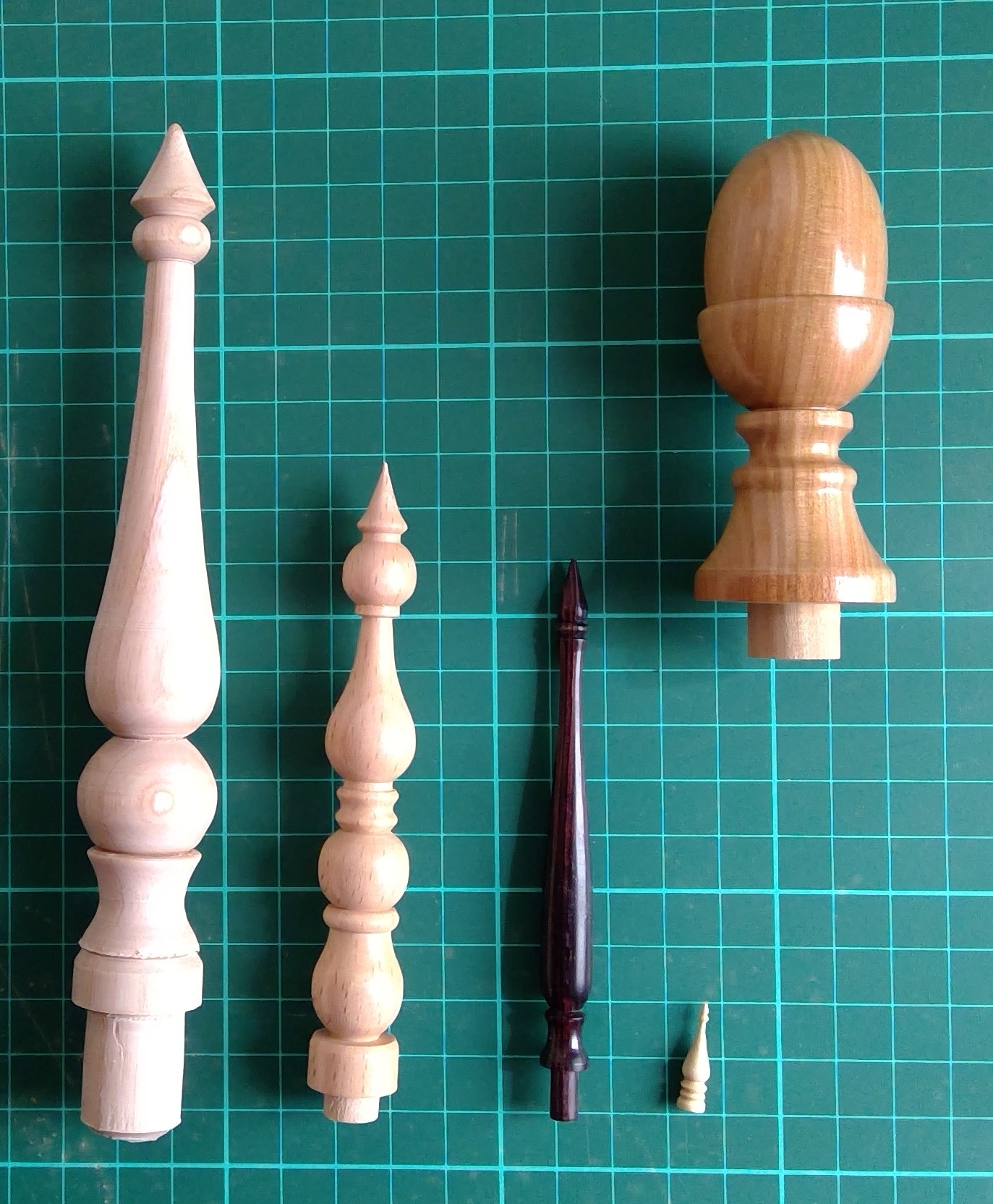
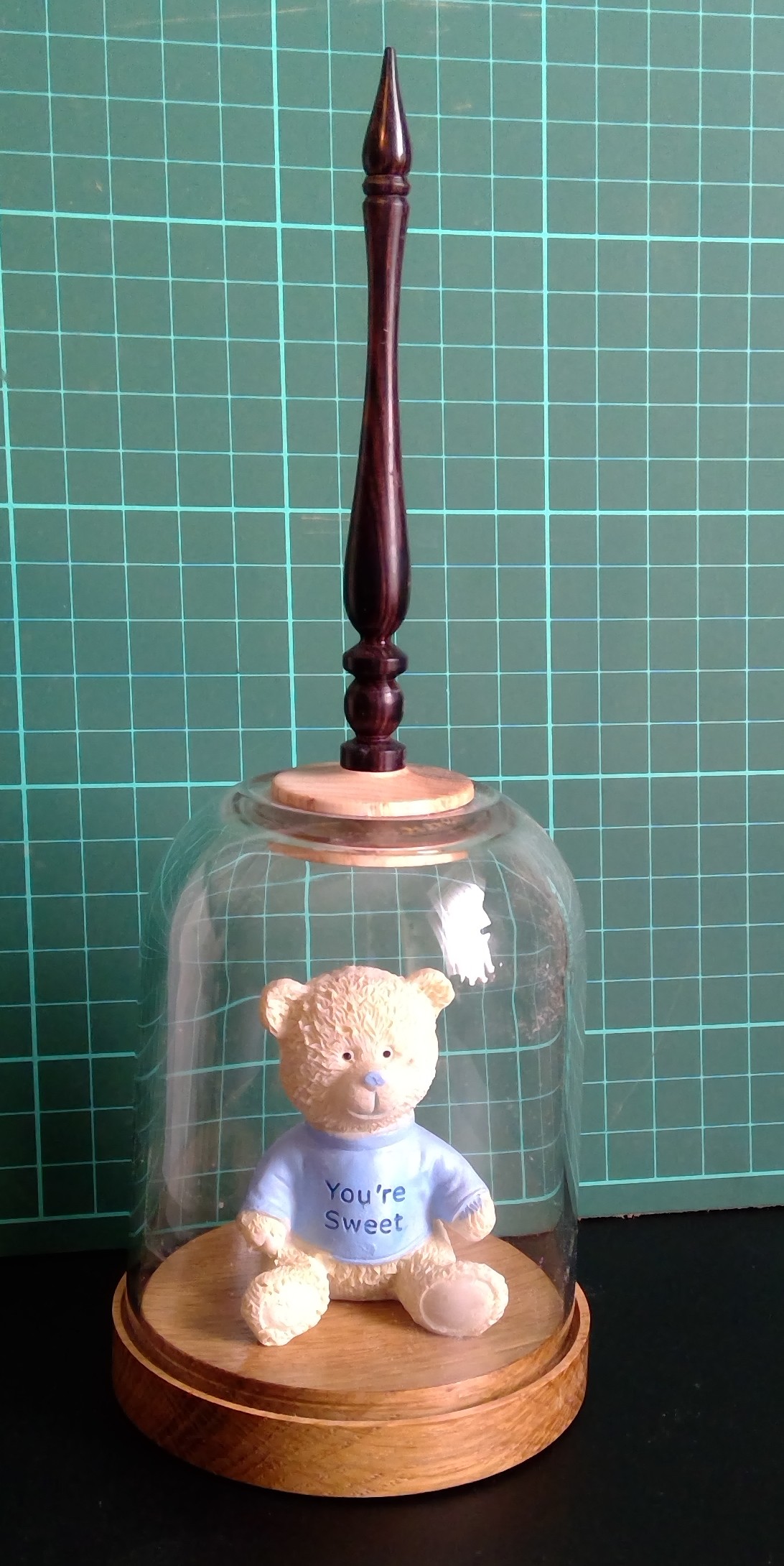
The examples I brought demonstrate designs that didn’t quite work, because they were too fussy. The finial on the ‘teddy bear jar’ failed because it had a point that was too big, and an ogee that flaired out again for no reason. One collar or bead would have been sufficient, the rest was excess, and the base was a different colour, adding more confusion. The dark wood finial in the group of 5 finials would have been better.

The two finials on the left of the group of five are also too fussy and have no theme or plan, the tiny finial is therefore the most successful of the group, with the exception of the ‘Acorn’ which is possibly not a finial at all. The ‘Acorn’ is a device used in furniture construction where a back or side of a chair or couch can be folded down. When in the upright position it is held in place with a piece of cord that is looped over the acorn, which has a cove to hold the cord in the proper place and the top is nicely rounded for safety and also for its tactile properties.

I do not, as a rule, use finials in my work but have been commissioned to make finials for architectural features on the gable ends of summerhouses, dormer windows, dovecots etc.

If you are mainly a bowl turner or pen maker then you are extremely unlikely to want to make a finial, but finials can be a useful way to add a bit of interest to the termination of larger pieces of work.

Rolf

Facebook

We have a web site and Facebook account, both do roughly the same thing but in slightly different ways. Many people find Facebook quicker and easier to use, while others like the traditional way of accessing information in a ‘wider’ way rather than the ‘linear’ way Facebook works.

It would be great if you would make yourself a link on the front/home page of your computer/ table/ phone/ smart fridge.

Click on this to go to our Facebook presence

Sharpening the Club Tools

Our recent sharpening workshop was well attended and everyone seemed to think it was worthwhile and successful. We only managed to get through the Spindle Roughing Gouge  and the Bowl Gouge but everyone seemed keen to have a further workshop to cover the remaining tools so I’ll try and get a date arranged for that sometime soon.

One of the key outputs from the workshop was the following list of rules which were discussed, debated and agreed unanimously by all who attended:

  1. All club tools must only be sharpened on a pro-edge
  2. All club tools must only be sharpened to the following standard grinds:
    • Spindle roughing gouge: 45° using v-block
    • Bowl (deep-fluted) gouge: 45° bevel angle standard (aka short) fingernail grind
    • Spindle (shallow-fluted) gouge: 45° bevel angle standard (aka short) fingernail grind
    • Skew: 15° using triangle block
    • Parting Tool: 20° using side of the v-block
    • Scraper: 80°
  3. Blunt or unusable tools must be sharpened or put in the red Tools To Be Sharpened box (i.e. not put back on the shelf)

Some explanatory notes:
The main purpose of these rules is to keep things as simple as possible and thereby make it easier for members of any ability to sharpen tools well. This should reduce the chance that tools will be sharpened poorly or not at all for fear of getting it wrong.

By “all club tools” we mean the six standard tools listed above. Exceptions are hollowing tools, texturing tools and the like.

If you are proficient enough to start using long or extra long grinds then you can adapt your own tools. For simplicity, club tools will only have the short grind.

Our standard grinds are the same as those suggested by Robert Sorby: see pic below or their instruction video.

sharp

Pencils used by Andrew Hall

Following the excellent demo on turning a hat by Andrew Hall, members have asked for details of the pencils he uses to colour the brim. In Andrew’s Hat Turning instruction manual he describes them as Derwent Drawing pencils Sepia range. He uses Black, Terracotta, Chocolate and Olive colours.

There is a copy of the manual and 2 DVD’s in the Club library.

Cutting fresh oak

If you use your bandsaw to cut any of the fresh oak from Danevale, check that the blade is clean as soon as you have finished. I didn’t and found that the dust was compacted onto the blade and spent an hour scraping the dust off ! The left side where the dust was pressed between the blade and the wheel was much worse than the right side.

Still, two 12″ bowls roughed out from the chunks I ‘acquired’.

Dust Mask & Air Filter

Well I’m currently suffering from my fourth or fifth sore throat and cold in the past six months and wood dust is strongly suspected in playing a part. Reading up on these things I fear I may have become sensitised to some, maybe all, types of wood dust. Sensitisation is where dust causes very small levels of damage that you don’t even notice, but they  build up gradually over time until all of a sudden you find yourself intolerant to even the smallest amounts. I think that’s where I might be and of course there is no remedy other than not breathing the stuff in in the first place.


So how do I stop breathing the stuff in?

To date I have been using a disposable face mask and an extractor that sucks the dust out at source when I am sanding. But  sanding isn’t the only cause of dust and direct extraction will never be able to capture all the dust created. Furthermore, the face mask is cheap and probably doesn’t provide a snug enough fit to be fully effective.

So I need two things:

  1. A good mask
  2. An air filtration system

I have tried a full face mask and really don’t think I could suffer one, so I’m thinking of getting one of these for £31:

http://www.axminster.co.uk/vitrex-vitrex-twin-filter-respirator-prod719630/

And for the air filtration I’m tempted with this for £220:

http://www.axminster.co.uk/jet-jet-afs-500-air-filtration-system-prod21189/

Previously I’ve always baulked at the price but I’m slowly beginning to heed the sage wisdom given to me many moons ago: they’re not cheap, but they’re cheaper and more readily available than a new pair of lungs.

So does anyone have any thoughts on these potential purchases? I’m particularly interested to hear from anyone who knows of better products at lower prices 🙂

Cheers, Phil Jones