
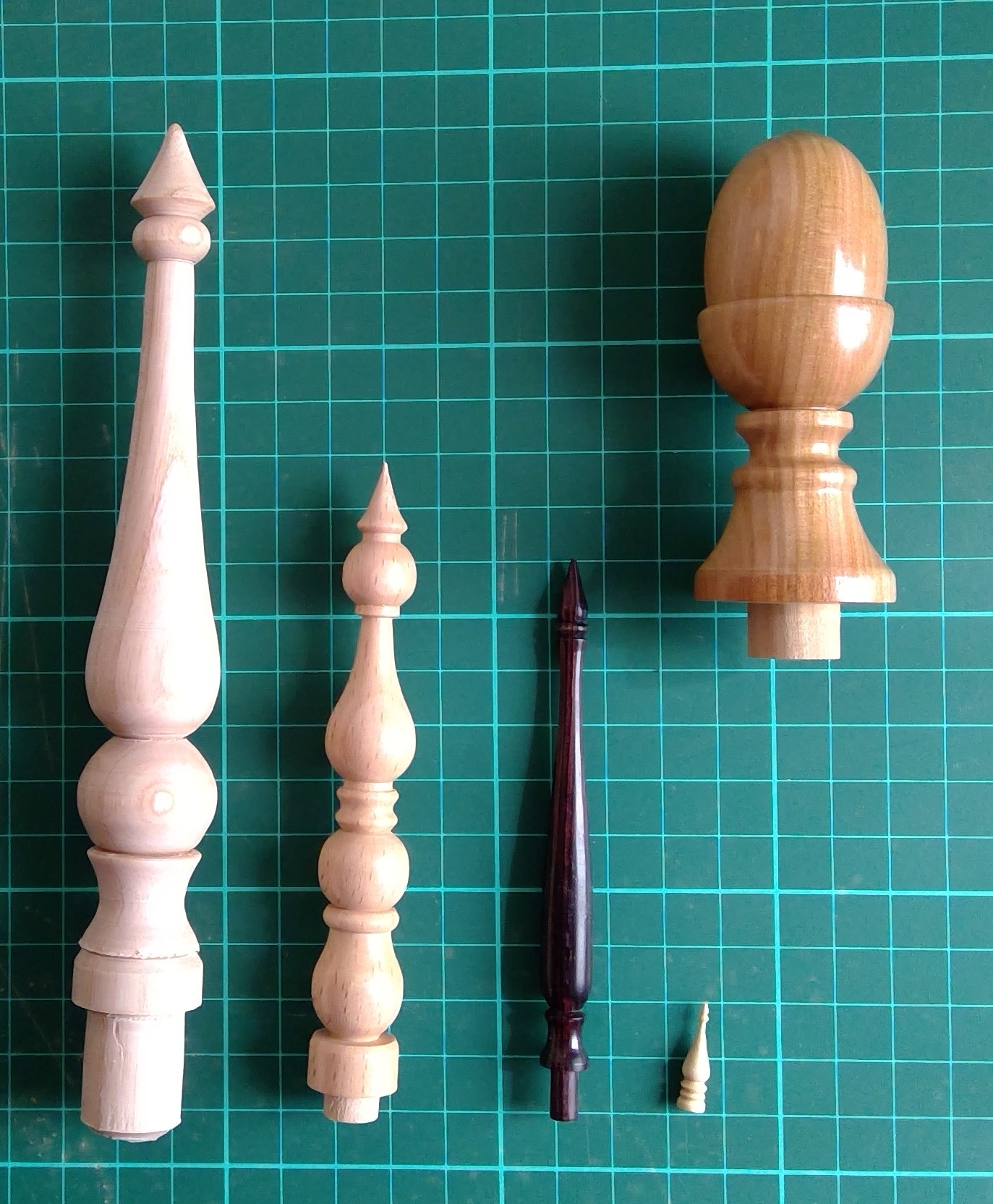
Finials : A decorative, slender, and vertical element, used to cap the top, or bottom, of a box, lid, hollow form or ornament, stair post, curtain rod, lamp, furniture or architecture.
In my demo I started with a 2 minute video of the Finale of a piece of classical music, to show the end, or final bit, of a piece of music. I chose the particular clip because this composer (Beethoven) is well know for his finales going on a bit, just when you think he has come to the end he adds another bit, and another, until it almost becomes messy and confusing – some people love it, others find it just too fussy. I played 2 minutes of a finale that was over 10 minutes long.
A finale is a musical ending, a finial is a woodturning ending, each one, if properly executed, can be a masterpiece, or a piece of frippery that is overly ornate and should have been ended long ago.
Some woodturners feel obliged to show off their skills by adding too many elements, and thereby overcomplicating the item.
Keep it simple !
The tools I used, or brought with me, were seven skew chisels, a spindle roughing gouge and two small spindle gouges. In reality I could have managed with two skew chisels and one small spindle gouge .
When making finials it is important to use dense wood, with no knots, pith or figure – and essential that the grain runs lengthwise, not crossgrain that would far too easily snap.
Pear, Holly, Beech, Cherry, Ebony, Mahogany etc. would be suitable, anything that is tight grained and ‘bland’ so that the figure of the wood does not detract from the clean line or shape of your finial.
Most finials come to a point with a collar, ogee, sphere, cove, bead and step somewhere in the design.
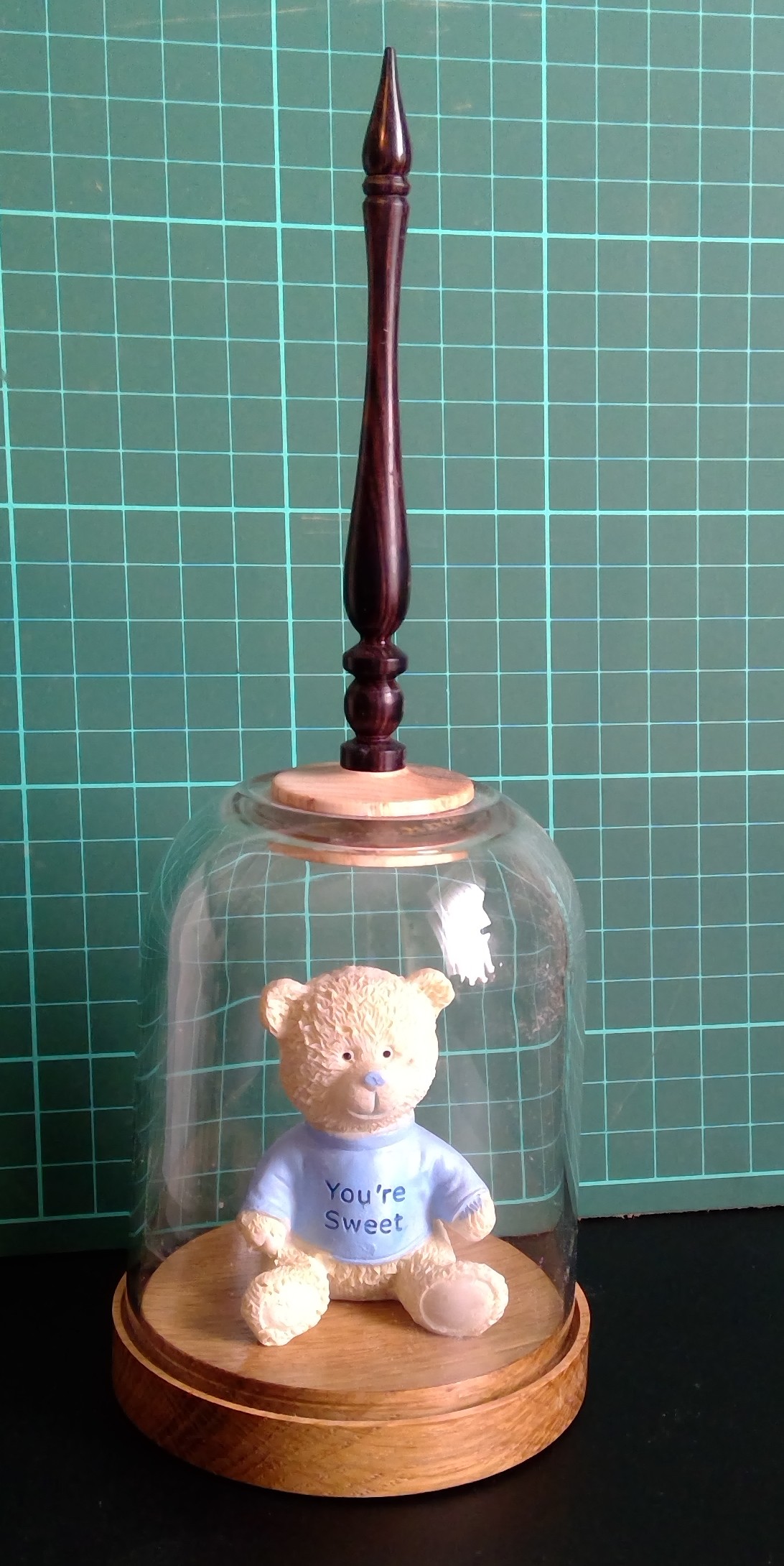
The examples I brought demonstrate designs that didn’t quite work, because they were too fussy. The finial on the ‘teddy bear jar’ failed because it had a point that was too big, and an ogee that flaired out again for no reason. One collar or bead would have been sufficient, the rest was excess, and the base was a different colour, adding more confusion. The dark wood finial in the group of 5 finials would have been better.
The two finials on the left of the group of five are also too fussy and have no theme or plan, the tiny finial is therefore the most successful of the group, with the exception of the ‘Acorn’ which is possibly not a finial at all. The ‘Acorn’ is a device used in furniture construction where a back or side of a chair or couch can be folded down. When in the upright position it is held in place with a piece of cord that is looped over the acorn, which has a cove to hold the cord in the proper place and the top is nicely rounded for safety and also for its tactile properties.
I do not, as a rule, use finials in my work but have been commissioned to make finials for architectural features on the gable ends of summerhouses, dormer windows, dovecots etc.
If you are mainly a bowl turner or pen maker then you are extremely unlikely to want to make a finial, but finials can be a useful way to add a bit of interest to the termination of larger pieces of work.
Rolf